 |
GemaMesh
The GeMA Mesh Plugin
|
Loading...
Searching...
No Matches
|
GemaMesh
The GeMA Mesh Plugin
|
A class used to provide all the geometric information needed by the topology and query Uibhm classes. It is implemented as a thin wrapper over the GmpGemaMeshData and GmpCellMeshData structures. By using this lower level abstraction than a GmCellMesh, we can avoid some virtual method calls and do some optimizations. Removing that dependency should be easy enough. More...
#include <uibhmGeometry.h>
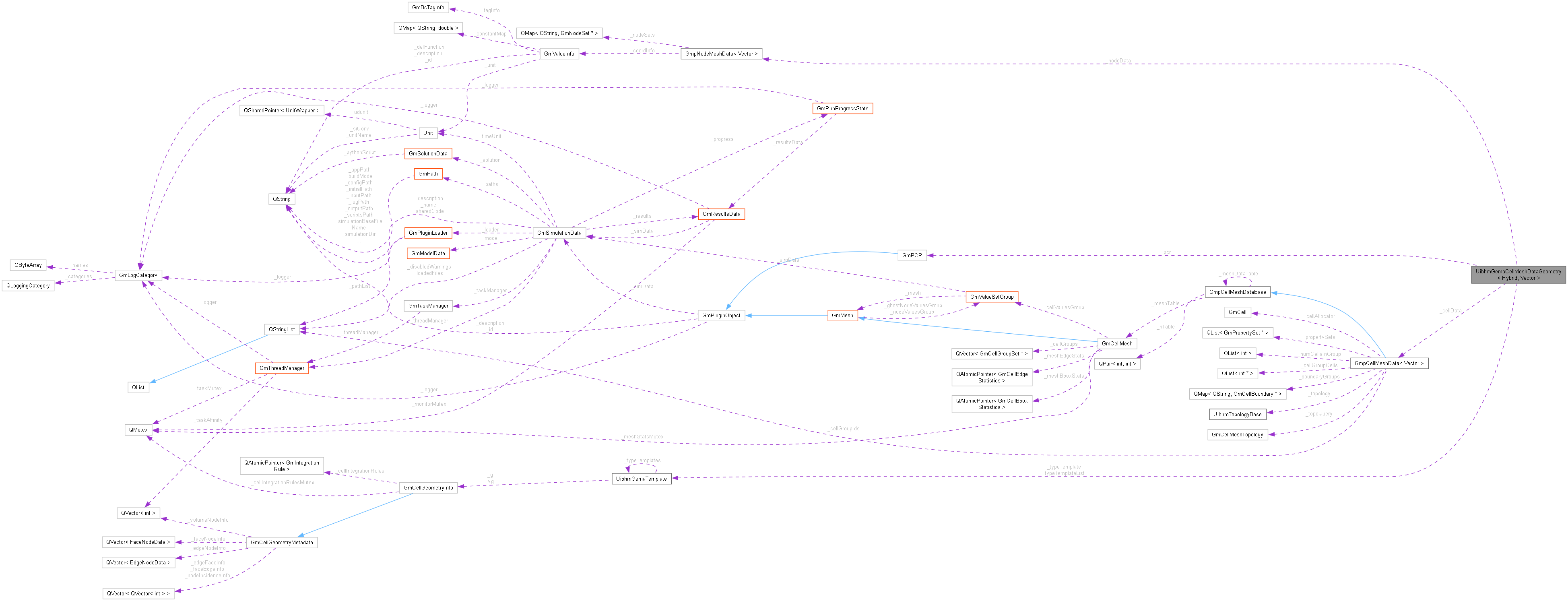
Public Types | |
| enum | { IsHybrid = Hybrid } |
| Saves the used Hybrid template parameter for query by other classes. | |
| template<typename U > | |
| using | VectorType = Vector<U> |
| The vector type used by the mesh. | |
| using | NodeData = GmpNodeMeshData<Vector> |
| The mesh node data. | |
| using | CellData = GmpCellMeshData<Vector> |
| The mesh cell data. | |
Public Member Functions | |
| UibhmGemaCellMeshDataGeometry (NodeData *nodeData, CellData *cellData, const GmPCR *pcr) | |
| Constructor. Receives as parameters the Gema node and cell data structures for this mesh. | |
| bool | updateCellTypes (int numAddedCells) |
| Updates the set of mesh cell templates (types) along with other metadata information assuming that numCells where added to the mesh after the topological structure was built. Assumes that the added cells are the cells with the highest id numbers in the mesh. Returns false on errors, true on success. It is considered an error to add solid elements to a not empty surface mesh. It is also an error to attempt to add elements of a different type to a not Hybrid mesh. | |
| int | numNodes () const |
| Return the number of mesh nodes. | |
| int | numCells () const |
| Return the number of mesh cells (including any 'strange' elements) | |
| GmCell * | cell (int cellId) |
| Returns the cell object from its id. | |
| bool | solid () const |
| Returns true if the mesh includes any solid cell (a cell with more than one face) | |
| bool | hybrid () const |
| Returns true if this mesh contains (or supports) hybrid cell types. It will always return true if the mesh includes 'strange' cells, even if all the other common cells are of the same type. | |
| bool | hasInterface () const |
| Returns true if the mesh includes any interface element. | |
| bool | strange () const |
| Returns true if the mesh includes "strange" cells. A surface mesh has strange cells if it includes bar cells while a solid mesh has stange elements if it includes bar or surface cells. Those 'strange' elements make the mesh non-manifold, and are ignored by the topology module. | |
| const UibhmGemaTemplate *const * | typeTemplates () const |
| Returns a vector with GM_NUM_CELL_TYPES entries storing the templates for the used cell types. A vector entry will be NULL it the associated type is not present on the mesh or if it is a strange cell type. | |
| void | faceVertices (int cellId, int face, QVarLengthArray< int, 10 > &nodeList) const |
| Fills nodeList with the set of vertices for the given element's face, where the face is defined by its local index in the element definition. The pre-alloc size of 10 should be enough for any common element type. | |
| void | faceNodes (int cellId, int face, bool mid, QVarLengthArray< int, 10 > &nodeList) const |
| Fills nodeList with the set of nodes for the given element's face, where the face is defined by its local index in the element definition. If mid is true, that includes an eventual quadratic mid surface node. If false it will not be accounted. The pre-alloc size of 10 should be enough for any common element type. | |
| void | faceEdgeVertices (int cellId, int face, int edge, int *first, int *last) const |
| Returns the pair of vertices for the given element's face edge, where the face is defined by its local index in the element definition and the edge by its local index in the face definition. | |
| void | faceEdgeNodes (int cellId, int face, int edge, QVarLengthArray< int, 4 > &nodeList) const |
| Returns the list of nodes for the given element's face edge, where the face is defined by its local index in the element definition and the edge by its local index in the face definition. The list endpoints are the edge vertices. | |
| int | findNodeIndex (int cellId, int v) const |
| Given an element and a node belonging to it, returns the local index of this node in the element. Returns -1 if the node was not found. Ignores the possibility of duplicated nodes in the element definition, and in that case, returns the first node ocurrence. | |
| int | colapsedInterfaceNode (int cellId, int v, int localIndex) const |
| Given an element, a node belonging to it and its local index (possibly returned by findNodeIndex()), checks to see if this node is a colapsed node from an interface element (a node whose sibling on an aperture edge is equal to it). If it is, returns the sibling local node. Otherwise, returns -1. | |
| int | colapsedInterfaceEdge (int cellId, int face, int faceEdge, int refFace) const |
| Given an interface element, an aperture face (those shared with other interface elements and not with other regular solid elements) and an edge belonging to that face, checks to see if this face is colapsed into a single edge (the two edges shared by the aperture face with the opposite contact faces are the same). If it is, returns the local edge index (on the given aperture face) for that sibling "twin" edge. Otherwise, returns -1 (this includes returning -1 if the element is not an interface element or if the face is not an aperture face). If refFace is equal to -1, the faceEdge parameter should be the local index of the edge on face. Otherwise, refFace and face should be adjacent faces by faceEdge and faceEdge should be the local index of the edge on refFace. | |
| int | findFaceEdge (int cellId, int face, int v1, int v2) const |
| Given an element's face and the oriented pair of (global) vertices of one of that face's edge, searches for the local number of that edge. Returns the edge number or -1 if not found. This method version only searches for v1-->v2 oriented edges. | |
| int | findFaceEdge (int cellId, int face, int *v1, int *v2) const |
| Given an element's face and the pair of (global) vertices of one of that face's edge, searches for the local number of that edge. Returns the edge number or -1 if not found. This method version searches for both v1-->v2 and v2-->v1 oriented edges and will, if necessary, swap v1 and v2 to make sure that on return they are oriented in the face order. | |
| int | findFaceEdgeFromLocalNodes (int cellId, int face, int lv1, int lv2) const |
| int | findFaceEdgeFromMidEdgeNode (int cellId, int face, int v) const |
| Given a mid edge node from a face edge, finds that edge's index in the face. Returns -1 if not found. | |
| void | edgeVertices (int cellId, int edge, int *first, int *last) const |
| Returns the pair of vertices for the given element's edge, where the edge is defined by its local index in the element definition. | |
| void | edgeNodes (int cellId, int edge, QVarLengthArray< int, 4 > &nodeList) const |
| Returns the list of nodes for the given element's edge, where the edge is defined by its local index in the element definition. | |
| int | numSides (int cellId) const |
| Returns the number of sides(edges or faces) for the given element. Returns 0 for strange elements. | |
| void | sideVertices (int cellId, int side, QVarLengthArray< int, 10 > &nodeList) const |
| Returns the set of vertices for the given element's side, where the side is defined by its local (face or edge) index in the element definition. | |
| void | sideNodes (int cellId, int side, QVarLengthArray< int, 10 > &nodeList) const |
| Returns the set of nodes for the given element's side, where the side is defined by its local (face or edge) index in the element definition. For faces with mid cell nodes, it will be included and will be the LAST node in the list. | |
| int | midCellNode (int cellId) const |
| If the element has a mid surface or a mid volume quadratic node, returns the node index. Otherwise, returns -1. | |
| bool | quadraticMidEdgeNodeAdjacentVertices (int cellId, int localNode, int *v1, int *v2) const |
| Given a mid-edge quadratic node defined by its local cell index, returns the pair of (global) vertices of that edge by filling v1 and v2 and returns true. If the local node is a mid-surface node, returns false. Should not be called for vertex nodes or mid-volume nodes. | |
| void | vertexAdjacentVertices (int cellId, int localNode, QVarLengthArray< int, 4 > &nodeList) const |
| Given a local vertex number (a geometry node, NOT a quadratic node), returns the set of global vertices adjacent to the given one by filling nodeList. | |
| void | vertexAdjacentNodes (int cellId, int localNode, QVarLengthArray< int, 4 > &nodeList) const |
| Given a local vertex number (a geometry node, NOT a quadratic node), returns the set of global nodes adjacent to the given one by filling nodeList. If the element is linear, its result is equal to calling vertexAdjacentVertices(). For quadratic elements, returns the adjacent mid-edge nodes instead of the adjacent corner vertices (ignoring mid-edge nodes) | |
| const UibhmGemaTemplate * | tt (int cellId) const |
| Returns the template type for the given cell. Will return NULL for "strange" cells. | |
| int | co (int cellId) const |
| Returns the offset of the first node stored by the given cell. | |
| const int * | cn (int cellId) const |
| Returns the cell node list. | |
| const GmPCR * | pcr () const |
| Returns the PCR object used for model <--> internal cell and node id conversions. | |
Static Public Member Functions | |
| static size_t | encodeEdge (int v1, int v2) |
| Encodes the edge definde by v1, v2 into a 64 bits integer number. | |
| static void | decodeEdge (size_t edge, int *v1, int *v2) |
| Decodes the result of an encodeEdge() operation returning both nodes. Since encoded values are always stored with v1 < v2, the returned value might be the encodeEdge() parameters swapped. | |
Public Attributes | |
| NodeData * | _nodeData |
| The mesh node data object. | |
| CellData * | _cellData |
| The mesh cell data object. | |
| const GmPCR * | _pcr |
| The mesh PCR object to allow for needed model <--> internal cell and node id conversions. | |
| bool | _solid |
| Flag set to true if the mesh includes solid cells. | |
| bool | _strange |
| Flag set to true if the mesh includes "strange" cells. | |
| bool | _interface |
| Flag set to true if the mesh includes interface elements. | |
| const UibhmGemaTemplate * | _typeTemplate |
| The type template if the mesh has a single cell type that is not a strange type (not hybrid, not strange). NULL otherwise. | |
| const UibhmGemaTemplate * | _typeTemplateList [GM_NUM_CELL_TYPES] |
| A vector storing the template types in use by the mesh, indexed by cell type. Entries corresponding to cell types not present in the mesh or to strange types are filled with NULL. Filled correctly even if _typeTemplate is not NULL. | |
A class used to provide all the geometric information needed by the topology and query Uibhm classes. It is implemented as a thin wrapper over the GmpGemaMeshData and GmpCellMeshData structures. By using this lower level abstraction than a GmCellMesh, we can avoid some virtual method calls and do some optimizations. Removing that dependency should be easy enough.
Template parameters are a boolean flag defining if the mesh supports cells with multiple types or a single cell type. The second parameter is the Vector type used by the data classes. Keep in mind that a non hybrid class can not support strange elements.
|
inline |
Returns the offset of the first node stored by the given cell.
Check the documentation on GmpCellMeshData::CellPrototype for an explanation on that cast.
| int UibhmGemaCellMeshDataGeometry< Hybrid, Vector >::colapsedInterfaceEdge | ( | int | cellId, |
| int | face, | ||
| int | faceEdge, | ||
| int | refFace ) const |
Given an interface element, an aperture face (those shared with other interface elements and not with other regular solid elements) and an edge belonging to that face, checks to see if this face is colapsed into a single edge (the two edges shared by the aperture face with the opposite contact faces are the same). If it is, returns the local edge index (on the given aperture face) for that sibling "twin" edge. Otherwise, returns -1 (this includes returning -1 if the element is not an interface element or if the face is not an aperture face). If refFace is equal to -1, the faceEdge parameter should be the local index of the edge on face. Otherwise, refFace and face should be adjacent faces by faceEdge and faceEdge should be the local index of the edge on refFace.
IMPORTANT: should only be called for non strange elements
| int UibhmGemaCellMeshDataGeometry< Hybrid, Vector >::colapsedInterfaceNode | ( | int | cellId, |
| int | v, | ||
| int | localIndex ) const |
Given an element, a node belonging to it and its local index (possibly returned by findNodeIndex()), checks to see if this node is a colapsed node from an interface element (a node whose sibling on an aperture edge is equal to it). If it is, returns the sibling local node. Otherwise, returns -1.
IMPORTANT: should only be called for non strange elements
|
inline |
Returns the list of nodes for the given element's edge, where the edge is defined by its local index in the element definition.
IMPORTANT: should only be called for non strange elements
|
inline |
Returns the pair of vertices for the given element's edge, where the edge is defined by its local index in the element definition.
IMPORTANT: should only be called for non strange elements
|
inline |
Returns the list of nodes for the given element's face edge, where the face is defined by its local index in the element definition and the edge by its local index in the face definition. The list endpoints are the edge vertices.
IMPORTANT: should only be called for non strange elements
|
inline |
Returns the pair of vertices for the given element's face edge, where the face is defined by its local index in the element definition and the edge by its local index in the face definition.
IMPORTANT: should only be called for non strange elements
| void UibhmGemaCellMeshDataGeometry< Hybrid, Vector >::faceNodes | ( | int | cellId, |
| int | face, | ||
| bool | mid, | ||
| QVarLengthArray< int, 10 > & | nodeList ) const |
Fills nodeList with the set of nodes for the given element's face, where the face is defined by its local index in the element definition. If mid is true, that includes an eventual quadratic mid surface node. If false it will not be accounted. The pre-alloc size of 10 should be enough for any common element type.
IMPORTANT: should only be called for non strange elements
| void UibhmGemaCellMeshDataGeometry< Hybrid, Vector >::faceVertices | ( | int | cellId, |
| int | face, | ||
| QVarLengthArray< int, 10 > & | nodeList ) const |
Fills nodeList with the set of vertices for the given element's face, where the face is defined by its local index in the element definition. The pre-alloc size of 10 should be enough for any common element type.
IMPORTANT: should only be called for non strange elements
| int UibhmGemaCellMeshDataGeometry< Hybrid, Vector >::findFaceEdge | ( | int | cellId, |
| int | face, | ||
| int * | v1, | ||
| int * | v2 ) const |
Given an element's face and the pair of (global) vertices of one of that face's edge, searches for the local number of that edge. Returns the edge number or -1 if not found. This method version searches for both v1-->v2 and v2-->v1 oriented edges and will, if necessary, swap v1 and v2 to make sure that on return they are oriented in the face order.
IMPORTANT: should only be called for non strange elements
| int UibhmGemaCellMeshDataGeometry< Hybrid, Vector >::findFaceEdge | ( | int | cellId, |
| int | face, | ||
| int | v1, | ||
| int | v2 ) const |
Given an element's face and the oriented pair of (global) vertices of one of that face's edge, searches for the local number of that edge. Returns the edge number or -1 if not found. This method version only searches for v1-->v2 oriented edges.
IMPORTANT: should only be called for non strange elements
| int UibhmGemaCellMeshDataGeometry< Hybrid, Vector >::findNodeIndex | ( | int | cellId, |
| int | v ) const |
Given an element and a node belonging to it, returns the local index of this node in the element. Returns -1 if the node was not found. Ignores the possibility of duplicated nodes in the element definition, and in that case, returns the first node ocurrence.
A node can appear twice for interface elements with a colapsed aperture edge, or even 3 times if the interface element has extra dof (flow) nodes. If that case needs to be handled, colapsedInterfaceNode() can be of use. IMPORTANT: should only be called for non strange elements
 1.12.0